Signal-First Demand Generation: Turning Buyer Intent into Predictable Pipeline – Market Wavegen

Most pipeline problems are not caused by a lack of activity.
They are caused by poor timing.
By the time most B2B buyers speak with sales, their decision is already taking shape. Research shows that buyers complete up to 70 to 80 percent of their evaluation before engaging with a vendor. They research independently, compare options, consult peers, and align internally long before a form fill ever occurs.
This white paper from Market Wavegen introduces a new approach called signal-first demand generation. It explains why traditional demand models fail to deliver predictable pipeline and how revenue teams can identify buying intent earlier, activate outreach at the right moment, and convert signals into measurable revenue.
Rather than chasing leads, signal-first demand focuses on detecting buying motion while decisions are forming.
You will learn how:
- Most pipeline leakage happens before sales engagement begins
- Market Wavegen defines signal-first demand as timing driven revenue activation
- Buyer intent forms long before traditional MQLs appear
- Signal quality matters more than signal volume
- Early intent detection improves conversion and forecast accuracy
- Sales performance improves when outreach matches buyer readiness
- Signal based activation aligns marketing and sales execution
- Predictable pipeline comes from sequencing, not volume
The paper begins by outlining the reality of modern B2B buying. Buyers now self-educate, compare vendors digitally, and delay sales engagement until late in the decision process. Traditional demand systems, built around form fills and linear funnels, are poorly suited to this reality.
Market Wavegen explains why this mismatch creates common failure patterns. Marketing reports activity while sales questions lead quality. Outreach happens too late. Pipeline appears full but fails to convert. Forecast confidence declines because timing signals are missing.
Signal-first demand generation addresses this problem by reversing the model. Instead of waiting for leads, it identifies high-intent behavior early and activates engagement based on signal strength and context.
The white paper defines a six-stage signal dependency framework:
- Buyer signals captured from real behavior
- Signal qualification based on intent strength
- Account prioritization using verified buying motion
- Orchestrated activation aligned to signal type
- Sales engagement driven by context and timing
- Pipeline attribution tied directly to signal origin
Each stage depends on the one before it. If signal quality is weak, everything downstream breaks. Market Wavegen emphasizes that signal-first demand is not a channel strategy but a sequencing strategy.
The paper also clarifies what qualifies as a meaningful buyer signal. High-value signals include competitive research, pricing evaluation, technology replacement activity, and role-based hiring trends. Low-value signals such as one-off content views or anonymous traffic spikes are filtered out.
Once signals are validated, activation becomes highly targeted. Vendor comparison signals trigger competitive positioning. Replacement signals trigger migration messaging. Expansion signals activate use-case driven outreach. Timing determines message, and message determines conversation quality.
The white paper includes a visual framework showing how signal-first demand connects buyer behavior, activation, and sales engagement into a single revenue system. It also contrasts traditional funnel models with signal-based pipelines, showing why early intent leads to higher conversion and faster deal velocity.
Market Wavegen outlines common failure modes, including over-triggering weak signals, delayed response, lack of sales context, and unclear attribution. To prevent these issues, the framework includes built-in controls such as minimum signal thresholds, decay rules, and mandatory context delivery to sales.
Sales adoption is central to the model. Every routed opportunity includes a signal timeline, inferred buying stage, recommended messaging, and disqualifying indicators. Sales teams are not asked to trust marketing. They are given evidence.
The paper concludes with an adoption roadmap covering three phases: signal foundation, activation alignment, and revenue measurement. It also outlines the role of Market Wavegen as a signal-first GTM partner that helps organizations identify real buying intent, activate accounts precisely, and tie activity directly to pipeline and revenue.
This white paper is designed for CMOs, CROs, revenue leaders, demand generation teams, and GTM operators who want to replace volume-driven lead models with predictable, signal-based pipeline creation.
Download the white paper from Market Wavegen to learn how signal-first demand generation transforms buyer intent into forecastable revenue.
Recommended Reads
Continue exploring our insights
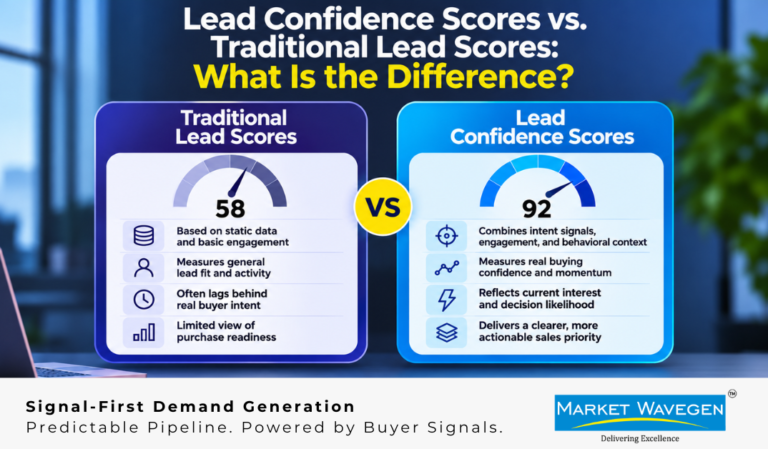
Lead Confidence Scores vs. Traditional Lead Scores: What Is the Difference?
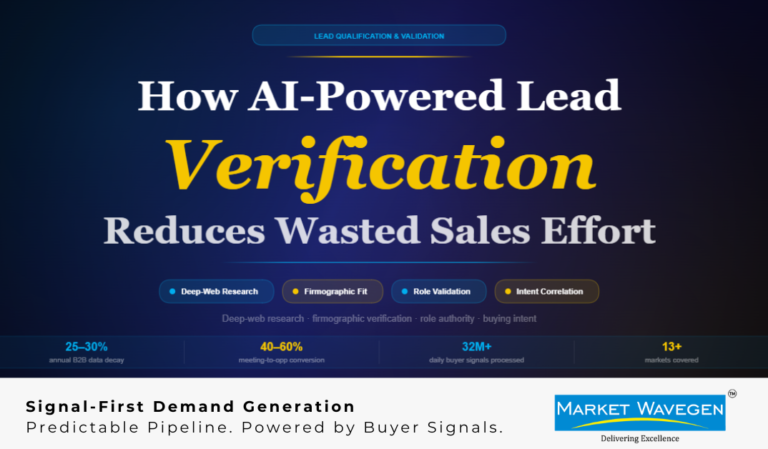
How AI-Powered Lead Verification Can Reduce Wasted Sales Effort
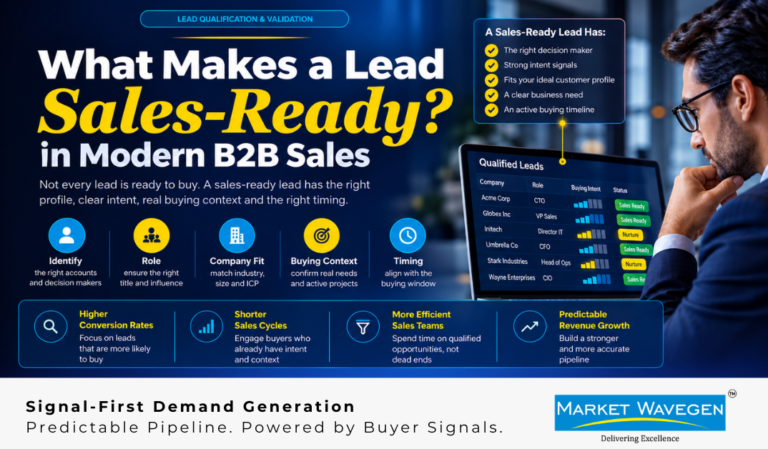
What Makes a Lead Sales-Ready in Modern B2B Sales?
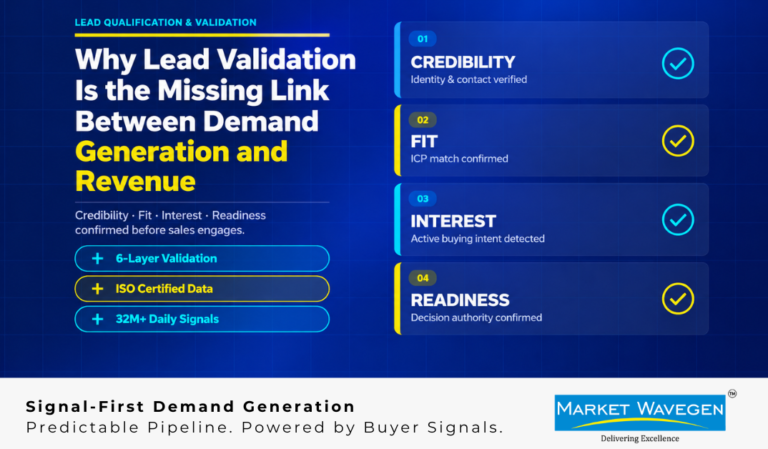
The gap that costs B2B revenue teams more than any campaign ever could.
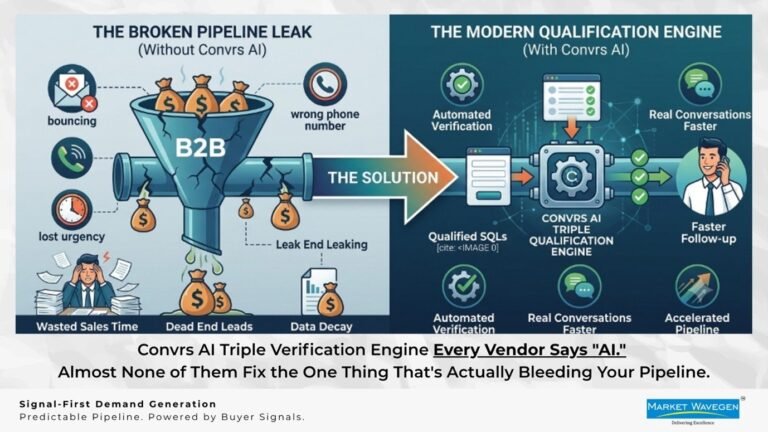
Convrs AI Triple Verification Engine: Every Vendor Says “AI.” Almost None of Them Fix the One Thing That’s Actually Bleeding Your Pipeline.
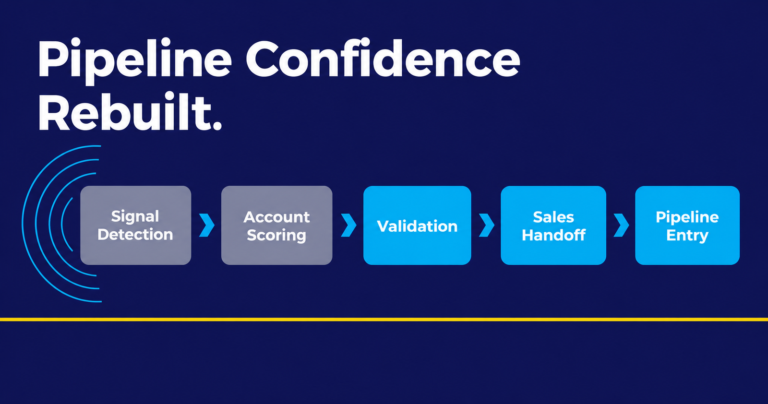
Why Your Pipeline Confidence Is Broken — and How Signal Intelligence Fixes It

Your MQL Is Not a Sales Lead: The Costly Mistake Killing B2B Pipeline
← Swipe to explore more →