
Each organization is promoting with content, however only one out of every odd organization is doing content advertising. The contrast between the 2 is much of the time only straight-up terrible substance. What’s more, there’s a ton of it. Be that as it may, what is the expense of this awful satisfaction?
As indicated by eConsultancy, awful happy costs B2B organizations $50 billion. What’s more, that is simply B2B organizations. Customer brands make up around 40% of the economy so add them in with the general mish-mash and we’re taking a gander at a $90 Billion issue. That is a ton of Benjamins.
Here, we’ll jump somewhat more profound into the expense of awful happiness, cover the motivations behind why such a lot of terrible substance exists, and how we can make content that really comes to, connects with, and changes new clients over completely to our business.
Fast Action items:
- Awful happiness costs organizations billions of dollars consistently
- The great substance is sound, significant, and arranged for a connected experience
- Awful happy disintegrates your believability and pipeline by making boundaries to trust and commitment
- Making a client-centered content system gives the arrangement expected more, greater substance and better return for money invested
What is Good Content?
High-quality content accomplishes the goal of answering a customer question with authority and credibility. For example, I’ve written more than 1,000 articles here on this blog. And while quantity certainly doesn’t mean that what I write is any good, practice does help.
Good content not only serves customers, it serves the business as well. Quality content-marketing reaches, engages, and converts new customers based on trust built through a quality content marketing strategy.
We define quality content marketing as:
- Customer-focused
- Consistent
- Comprehensive
- Cost-effective
Here are some additional components of good content before we dive into the bad.
Good Content Is Credible
When I trained hundreds of writers at SAP to publish on our blog, I told every one of them that the first thing they ever write may not be very good, but the hundredth will be awesome. Some of the things I trained them on was to build credibility over time by being a curious students of their topic, sharing what they learned, and what they thought about what they learned on their topic of interest.
Good Content Shows Interest or Passion
One of my favorite content marketing quotes is from Mark Twain who said “write about what you know.” Ok so maybe good content doesn’t need to come from a deep-seated passion for your topic. I struggled to have a passion for Cloud Computing. But I found a way to make it interesting.
Good content should convey a natural curiosity to answer the question and requires at least some level of interest on the writer’s part.
Good Content Delivers On Search Intent
There’s been a lot of talks lately about writing for humans vs writing for people. And while we use SEO to research topics, we write for people to answer their search intent. So we imagine we’re standing with someone in real life, and when that person asks a question, we try and make sure our content answers that question as well as possible.
I don’t believe even the best AI can do that yet!
Good Content Is Only As Long As It Needs To Be
We get a lot of questions about content length and quality.
How long should a blog post be? Only as long as it needs to be to answer the question!
Our research concluded that under 1,000 words and Google is less likely to show your answer. Longer content is more likely to rank but when time and budget is limited, it makes the most sense to publish more often than to publish longer content.
Good Content Is Formatted For Viewer Engagement
Do you like to read 12-sentence paragraphs where the sentences are 3 lines long, written like a PhD student? Probably not. We use a checklist to write what we think is a perfect blog post format to try and use white space as much as possible. To use summary points in headlines, bullets, and short sentences.
Some other format considerations:
- 3-5 key takeaways
- Visuals that add to the content
- Videos
- Links to internal and external sources
- Active vs passive voice
We use the following checklist for every single piece of content we deliver for our clients. Feel free to download for your own use or send me a quick message and I’ll send you a google sheet you can use.

What is Bad Content?
Most content stinks because it focuses on promoting your business or your point of view. There’s a name for people that make everything all about themselves. (Message me if you don’t know it!)
Bad content is overly promotional, self-serving, poorly written, duplicative, un-original, or hard to read.
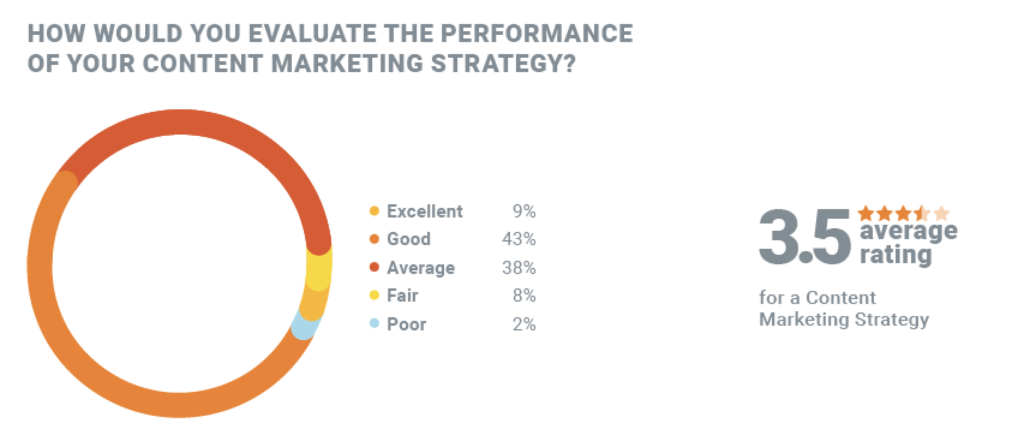
And yet the majority of people rate their own content as better than average. This is called illusory superiority, a form of cognitive bias that makes most of us think we are better than average when that is mathematically impossible.
I have said that the biggest mistake most content marketing makes is trying to sell in your content marketing. But actually, the biggest mistake is creating something that never gets used at all.
What is The Cost of Bad Content?
According to Forrester, 60-70% of content goes completely unused!
That’s the worst kind of content because it never even gets the chance to be judged as bad. You would be better off throwing your budget in the trash and going out to lunch for the whole day every day. OK, so take your marketing or communications budget, multiply by 60%, and that is the cost of bad content.
I’m totally serious. When I was at SAP, I asked our marketing team to show me how many demand-generation campaigns delivered at least 1 lead. The answer: is 44%. That’s right nearly 60% of our demand generation campaign budget was for campaigns that didn’t produce a single lead. How does that happen? (Answer below).
The success I achieved there was not because I was above average in any way. I just suggested we stop doing the stuff that produced no value. And start doing the stuff that helped our customers and drove ROI. 7x ROI was the result. The average marketing campaign at SAP at the time delivered negative ROI. (I’m excluding events. SAP events were awesome ROI generators – at least at the time.)
So if 60% of the content we create never gets used, and nearly 60% of lead gen programs don’t produce a single lead, the just use my simple math above to calculate the cost of bad content.
And if you think you are better than average (haha – see what I did there), you’re not! I’ve done this analysis at about a dozen companies and guess what the answer was to the question: how much content did we produce that created any value at all? The answer was an average of 40%. 60% produced zero value of any kind.
More than half of what you do is likely wasted, bad content!
Why Do We Create Bad Content That Never Gets Used?
I believe the main problem stems from the common marketing mistake of focusing on activities instead of results (my blood is starting to boil).
We create stuff because someone told us to. And that stuff is overly promotional and self-serving because that is the natural instinct of most people.
Behind every piece of bad content is an executive who asked for it!

We need to resist our natural instinct to promote our business and just try and answer a customer’s honest question.
How To Create Less Bad Content
Here are some additional tips to making sure you create more, good content. That is, tips to create a higher quantity of quality content. See? This isn’t even an easy thing to say, let alone an easy thing to do!
- Train your team on what content marketing really is.
- Document your content marketing strategy to gain alignment around the objectives and support from senior executives.
- Emulate some of the best examples of quality content marketing from companies like Nutanix, Televerde, DivvyHQ, and more.
- Consider mapping content to the buyer journey based on keyword/search signals.
- Invite your readers to engage more deeply through subscriptions and offers and turn your blog into a lead generation machine.
- Measure your content all the way to revenue.
- Spell stuff really well, make all the good words and take the time it takes to write a quality piece of content.
Busting Some Myths
Finally, a couple of myths I have heard so many times I want to puke: content needs to be original and it needs to present a unique point of view. I call BS on these points because:
- A. There are no completely new thoughts. Not really. We’re all just synthesizing the data around us and some of us are more skilled than others at presenting our thoughts about this data in creative and effective ways.
- B. No one cares about your unique point of view. Answering a customer question only requires you to uniquely care about your customers. Not about yourself.
Besides, even considering whether your thought is unique or new is selfish by nature. Consider instead whether your content is helping someone!
Recommended Reads
Continue exploring our insights

The gap that costs B2B revenue teams more than any campaign ever could.
The problem hiding in plain sight Most B2B organizations have a demand generation problem that doesn’t look like one. The campaigns are running. The content is performing. The leads are coming in. Marketing is hitting its MQL targets. On paper, the top of the funnel is healthy. And yet — quarter after quarter — pipeline underperforms. Sales cycles stall. Win rates disappoint. Forecasts miss. The CFO asks the same question, and no one has a satisfying answer. The problem is not the leads. It is what happens — or more accurately, what does not happen — between a lead being captured and a sales conversation beginning. That gap has a name: the missing validation layer. And for most B2B revenue teams, it is the single most expensive structural failure in their entire GTM motion. What lead validation actually means Lead validation is not a single checkbox. It is not email verification. It is not running a name through a contact database to confirm the record exists. Real lead validation answers four questions that determine whether a lead deserves sales attention: 1. Credibility — Is this a real person at a real company that could genuinely become a customer? Has the business been confirmed as legitimate, active, and operating in the right industry and geography? 2. Fit — Does this account match the ICP? Does the company size, revenue band, technology environment, and growth stage align with what the solution is actually built for? 3. Interest — Did this person engage with the content deliberately, or did a form get filled by someone who will not remember it tomorrow? Is there observable evidence of genuine category consideration? 4. Readiness — Is this account in an active evaluation window, or are they twelve months away from any buying decision? Is there urgency, or only vague curiosity? When all four are confirmed — and only when all four are confirmed — a lead is ready for sales engagement. Anything short of that, and a sales conversation is not an opportunity. It is a friction event that damages trust, wastes capacity, and quietly closes a buying window that was genuinely open. Why demand generation alone cannot close this gap Demand generation is built to create the signal — to put the right content in front of the right audience and attract the attention of accounts that could eventually become customers. It is not built to verify what happens next. The moment a prospect fills a form, downloads a report, or responds to an email, demand generation has done its job. What follows — confirming the identity, validating the fit, verifying the interest, and assessing the readiness — is an entirely different function. And in most B2B organizations, it either doesn’t happen at all, or it happens too slowly, too inconsistently, and too far downstream to matter. The industry data on this is unambiguous: These are not fringe findings. They represent the standard operating reality for the majority of B2B revenue organizations. And they point to the same structural conclusion: demand generation and sales engagement are two activities that have a critical third step between them — validation — that most teams have never built. The cost of skipping validation When a lead moves from capture directly to sales without passing through a validation layer, the consequences stack up quickly across the entire revenue organization. Sales capacity is consumed by qualification that should already be done. Every rep who picks up the phone to call a lead that turns out to be the wrong person, the wrong company, or the wrong timing has spent irreplaceable selling time on an activity that a validation system would have handled in minutes. Trust between sales and marketing erodes permanently. Once a sales team learns from experience that a large percentage of marketing-generated leads are not worth calling, they stop calling them. The pipeline they were supposed to work becomes invisible. Marketing doubles down on volume to compensate. The cycle worsens. Buyer urgency windows close before contact is made. A prospect who engaged with content today is not the same buyer three days from now. Priorities shift. Attention moves. Other vendors make contact. Delay — caused by the absence of a real-time validation layer — is often the difference between an opportunity that opens and one that closes before sales ever knows it existed. Forecast accuracy deteriorates. When unvalidated leads enter the CRM, they inflate pipeline. Sales managers and revenue leaders build forecasts on a foundation that looks solid but isn’t. The gap between projected and actual revenue becomes structural, not occasional. The four dimensions of a real validation layer Closing the gap between demand generation and revenue requires building validation as a permanent, systematic layer inside the demand engine — not as an afterthought, not as a manual SDR function, and not as a retrospective audit of why deals didn’t close. A complete validation layer operates across four dimensions simultaneously: Credibility ValidationEvery lead that enters the system is cross-referenced against deep-web data sources to confirm that the company is real, active, and operating in the relevant industry and geography. This step eliminates the phantom leads, the inactive businesses, and the misidentified records that consume disproportionate sales attention for zero commercial return. Firmographic Fit ValidationConfirmed leads are evaluated against ICP criteria — company size, revenue band, employee count, technology stack, growth indicators, and vertical alignment. A lead that passes credibility checks but fails ICP fit is not an opportunity. It is a distraction. Removing it at this stage protects sales capacity for accounts that could actually close. Engagement and Interest ValidationThe lead’s stated reason for engaging — and their actual engagement behavior — is confirmed through real interaction. An automated email referencing the specific asset they engaged with creates a second, independently verifiable data point and reinforces the interaction in the prospect’s memory. Engagement confirmation transforms a form-fill from an assumption into a documented signal. Readiness and Intent ValidationThis is the dimension most demand generation systems never reach.

Convrs AI Triple Verification Engine: Every Vendor Says “AI.” Almost None of Them Fix the One Thing That’s Actually Bleeding Your Pipeline.
How Market Wavegen’s Convrs AI Triple Verification Engine closes the gap between a form-fill and a real conversation before your sales team ever picks up the phone. The problem every B2B revenue leader already knows by heart A prospect fills out a form. Marketing marks it an MQL. Sales picks up the phone to follow up and hits a dead end. The number’s wrong. The email bounces. The person barely remembers downloading the asset, if they even filled out the form themselves. Days later, when someone finally does get a “real” conversation going, the moment has already passed the buyer has moved on, lost urgency, or is now talking to a competitor who called first. This isn’t a one-off annoyance. It’s a structural leak in nearly every demand generation motion running today, and 2026 has made it worse, not better because every vendor claiming “AI-powered” lead gen is pouring more volume into the same broken verification layer. The data backs this up, from every corner of the industry: Put plainly: the industry has spent the last two years bolting “AI” onto lead generation volume more signals, more scoring, more outreach cadences without fixing the one point of failure that determines whether any of it converts: is the lead even real, reachable, and still interested by the time sales calls? That’s the gap Convrs AI is built to close. Enter Convrs AI: the industry’s first Triple Qualification Engine Market Wavegen already runs demand generation on Mantech Mark™, its ISO-certified signal intelligence platform tracking 32 million+ daily buyer signals across a base of 147M+ professionals and 498M+ companies. Convrs AI is the next layer on top of that foundation purpose-built to eliminate the exact failure point sales and marketing teams have been living with for years. Instead of treating a form-fill as the finish line, Convrs AI treats it as the starting gun for a real-time, three-stage verification sequence: 1. AI-Enabled Research & Deep Verification The moment a lead fills out a form, Convrs AI doesn’t just check the fields the person typed. It runs a full deep-web research pass against the prospect’s stated identity cross-referencing industry, company revenue band, and job title against live, current-state data, not a static database snapshot. If something doesn’t line up a title that’s changed, a company that’s been acquired, a role that no longer exists the system flags it before your reps ever dial. 2. Instant Confirmation Email In parallel, Convrs AI triggers an automated confirmation email to the prospect, referencing the specific asset they engaged with. This does two things at once: it reinforces the interaction in the prospect’s memory (closing the “I don’t recall downloading that” gap), and it creates a second, independently verifiable data point a working email that the prospect can act on. 3. Human-Grade AI Voice Verification This is the layer most demand gen stacks simply don’t have. Convrs AI places a call to the prospect through a conversational AI agent that confirms the phone number is live, verifies the prospect engaged with the content, and captures their real interest level in their own words, in real time. No more sales reps discovering a dead number three call attempts in. No more “I have no idea what asset you’re referring to.” By the time a lead lands on a rep’s desk, it has already cleared three independent layers of verification: data accuracy, engagement confirmation, and voice-confirmed intent something no traditional MQL workflow, and no single-layer “AI lead scoring” tool, currently does. Why this matters more in 2026 than it did even a year ago The stakes here are compounding, not static: Convrs AI is built around a simple premise: verification has to happen at the moment of the signal, not days later when a rep finally gets a callback. That’s the shift from lead volume to lead certainty and it’s the differentiator most companies talking about “AI in marketing” in 2026 still haven’t built. The bottom line Every company is now saying “AI” in their positioning. Very few are pointing that AI at the actual point of failure the fragile, decaying, unverified moment between a form-fill and a sales conversation. Market Wavegen’s Convrs AI Triple Verification Engine: was built specifically to close that gap: verifying identity and firmographic accuracy through deep research, confirming engagement through an automated email touchpoint, and validating real interest through a live AI voice interaction all within moments of the original form-fill, and all before a single sales hour is spent. The result isn’t just cleaner data. It’s a fundamentally different starting point for every sales conversation: one where the rep already knows the number is real, the person remembers the interaction, and the interest is confirmed not assumed. Sources: Landbase 2026 Data Decay Rate Statistics; Salesmotion (2026) on B2B data decay and CRM data readiness, citing Validity’s 2025 State of CRM Data Management report and Salesforce research; Industry Select, “Measuring the High Cost of Bad Contact Data”; Marketing Sherpa research via Carla Johnson’s B2B Sales and Marketing Alignment statistics compilation; Forrester/Marketing Evolution 2019 study on marketing budget waste.

Why Your Pipeline Confidence Is Broken — and How Signal Intelligence Fixes It
The Scene That Plays Out Every Quarter The CRM looks healthy. The pipeline number is strong. The sales team sounds confident. The CFO signs off on the forecast. Then the quarter closes — and the numbers miss. This is not a sales execution problem. It is not a messaging problem. It is not even a lead volume problem. It is a pipeline confidence problem — and it starts the moment your team begins treating activity as intent. Why Most B2B Pipelines Cannot Be Trusted Every B2B revenue leader has felt the weight of this question: Why does our pipeline consistently fail to convert at the rate we forecast? The answer is structural. The average enterprise pipeline contains between 40% and 60% of deals that will never close — not because the sales team lacks skill, but because the accounts entered the pipeline before they were genuinely ready to buy. They filled a form. They downloaded a report. They opened three emails. None of these actions signal buying readiness. All of them signal vague awareness at best. When your pipeline is built on activity signals — clicks, opens, page visits, form fills — it looks full. It feels real. But it collapses when sales engages, because the underlying intent was never there. The result is familiar: This is the pipeline confidence crisis. And it is not solved by more leads. It is solved by better evidence. The Real Problem: Activity Is Not Intent Traditional lead scoring models were built to solve exactly this problem. They assigned numerical values to buyer actions and used accumulated scores to prioritise outbound effort. In a world where buyer journeys were linear and predictable, this approach made reasonable sense. In 2026, it no longer does. Today’s B2B buyers research anonymously. They compare vendors in communities your tracking pixels cannot reach. They build evaluation shortlists in Slack channels and peer review forums before your SDR ever sends the first email. They involve procurement, legal, and finance weeks before any vendor contact is made. By the time a contact scores highly in your marketing automation platform, they may already be three months into an evaluation cycle your team knows nothing about — and two of your competitors are already on their shortlist. This is the signal gap. And it is the structural cause of every pipeline confidence failure. The question your current system is asking is: “What did this person do on our website?” The question that actually predicts pipeline is: “What is this account actively doing in the market right now?” These are different questions. They produce different data. And they produce profoundly different pipeline quality. What Signal Intelligence Actually Measures Signal intelligence does not replace demand generation. It upgrades the evidence layer beneath it — replacing activity scores with behavioural intent that exists in the market, not just on your owned channels. At Market Wavegen, every program runs on Mantech Mark™, our ISO-certified signal intelligence platform that analyses more than 32 million daily buyer signals across industries, geographies, and buying journeys. Mantech Mark™ monitors five categories of real-market intent: 1. Research Behaviour The earliest indicator of active consideration. When an account begins investigating a category — not a specific vendor, but the problem category — it reveals the opening of a buying window before most competitors can see it. 2. Product Comparisons Side-by-side vendor evaluations signal shortlist-stage activity. An account comparing your category at this depth is not browsing. They are building a decision architecture. 3. Competitor Dissatisfaction Negative sentiment, contract complaints, churn indicators, and public switching intent. When a buyer is frustrated with their current vendor, there is a narrow window of high receptivity to alternatives. Flip Signals™ — our emotional buyer intent layer — captures not just what buyers do, but why they are doing it, detecting frustration, urgency, and optimism as distinct emotional signals. 4. Renewal and Contract Cycles Predictable pipeline entry windows tied to existing vendor contract dates. Accounts approaching renewal are structurally open to re-evaluation. Knowing when this window opens — before the account formally enters a buying process — is the single most reliable source of early-stage competitive advantage. 5. Hiring and Expansion Signals New role postings, leadership transitions, funding announcements, and geographic expansion all indicate budget availability and organisational readiness to invest. These are buying readiness signals hiding in plain sight. Signal intelligence does not tell you what buyers did on your website. It tells you what they are doing in the market — before they ever visit your website.

Your MQL Is Not a Sales Lead: The Costly Mistake Killing B2B Pipeline
There’s a quiet but expensive mistake happening inside most B2B organizations. It looks productive. It feels efficient. It shows up as speed, activity, and responsiveness. But in reality, it’s destroying pipeline. The moment a Marketing Qualified Lead comes in, sales jumps in. Calls are made within hours. Sequences are triggered. Calendars are pushed. And just like that, the opportunity is gone. Not visibly. Not dramatically. But permanently. Because here’s the uncomfortable truth: your MQL is not a sales lead. The Core Misunderstanding That Breaks Pipeline An MQL is not a buying signal. It’s a learning signal. When someone downloads a guide, attends a webinar, or clicks through a few emails, they are not raising their hand to speak to sales. They are trying to understand a problem. They are early. Curious. Uncertain. And most importantly, they are still forming their perspective. Yet most B2B systems treat this moment as a trigger for immediate sales outreach. That assumption creates friction at the exact moment when trust should be built. The result is predictable. And what gets logged in the CRM is deceptively simple: “Not interested.” But that’s not what actually happened. What Buyers Are Really Doing Before They Talk to You The modern B2B buying journey is not linear, and it’s definitely not public. Buyers spend the majority of their time researching independently. They explore options, validate assumptions, and build internal alignment long before they agree to speak with a vendor. By the time they are ready for a conversation, they’ve already: That means the real battle for pipeline happens before sales ever gets involved. The question is not how fast you can respond to an MQL. The question is whether you showed up during the part of the journey that actually matters. The Hidden Damage of Premature Sales Outreach Let’s make this tangible. A senior marketing leader engages with your content late at night. She’s researching a problem her team is facing. She downloads a guide. The next morning, your SDR calls. She’s caught off guard. She doesn’t remember the form. She’s in meetings. The call feels intrusive. She disengages. Three months later, she buys from a competitor. Not because they had a better product. But because they understood timing. They stayed present. They nurtured. They built familiarity. They earned trust before asking for a conversation. This is the part most teams miss. Pipeline isn’t lost because of poor sales execution. It’s lost because of premature sales entry. Why the Top of Funnel Is More Fragile Than You Think Top-of-funnel leads exist in a delicate state. They are aware enough to explore, but not ready to commit. They are evaluating ideas, not vendors. And they are highly sensitive to pressure. The moment outreach feels self-serving instead of helpful, the buyer disengages. Not loudly. Not visibly. Just quietly. And once that happens, the opportunity rarely returns. This fragility creates a cascading problem across the organization: What started as a timing issue becomes a systemic revenue problem. The Shift: From Lead-Based Thinking to Signal-Based Execution This is where most demand generation strategies need to evolve. Instead of treating every MQL as a sales-ready opportunity, high-performing teams treat it as a signal that needs to be understood, validated, and nurtured. This is the foundation of signal-first demand generation. At Market Wavegen, this shift is operationalized through a structured system: The goal is not more leads. The goal is better-timed conversations. What Should Happen After an MQL Converts The first 30 days after an MQL conversion are critical. And they do not belong to sales. They belong to marketing. Here’s what effective teams do differently. Start With Context, Not Action Instead of reacting immediately, analyze the signal. What did the buyer engage with? This context determines everything that follows. Build a Structured Nurture System A strong nurture sequence is not promotional. It is educational, relevant, and progressive. Over the next three to four weeks, the buyer should receive: Each touchpoint should add value without forcing a decision. Layer in Multichannel Reinforcement Email alone is not enough. High-performing teams reinforce messaging through: This creates familiarity and builds credibility over time. The buyer starts to recognize your perspective before ever speaking to your team. Watch for Real Buying Signals Not all engagement is equal. The shift toward sales should only happen when intent becomes clear. Key indicators include: This is where timing becomes precise. Where ConvrsAI Changes the Game Even when signals indicate readiness, jumping straight to a sales call is still risky. This is where validation becomes critical. ConvrsAI sits between marketing and sales as a qualification layer. It engages leads through AI-driven conversations across email and voice to: By the time a lead reaches sales, it is no longer just an MQL. It is a validated opportunity with clarity and confidence behind it. This fundamentally changes the sales conversation. Instead of discovery, it becomes progression. The Real Math Behind Pipeline Conversion Many organizations try to fix pipeline issues by increasing lead volume. But if conversion rates are low, volume only amplifies inefficiency. If your MQL-to-opportunity rate is below 15%, the issue is not supply. It’s timing and qualification. Signal-driven systems consistently outperform because they: The difference between a 12% conversion rate and a 40% conversion rate is not effort. It’s understanding. A Message to Sales Leaders The pressure to generate pipeline is real. Targets are aggressive. Timelines are tight. Expectations are high. But speed is not the answer. Precision is. Pushing MQLs to sales faster does not create pipeline. It destroys future pipeline. The organizations that are winning are not the fastest. They are the most aligned with buyer timing. They understand when to engage and when to wait. And they have the discipline to do both. Trust Is the Only Sustainable Advantage Today’s buyers are more informed than ever. They’ve read comparisons. Spoken to peers. Evaluated alternatives. By the time they talk to you, they already have an opinion. In that environment, trust becomes the only real differentiator. And trust is not

First 72 Hours After Lead Capture Decide Pipeline Outcomes
First 72 hours after lead capture determine pipeline success. Learn how to validate, qualify, and convert leads faster with signal-first systems. The moment pipeline is won or lost The first 72 hours after lead capture are where pipeline is either created or quietly destroyed. Most B2B teams assume conversion is a long game. In reality, timing is the deciding factor. A prospect who downloads a report today is not the same buyer three days later. Priorities shift. urgency fades. competitors enter the picture. This article breaks down why those first 72 hours matter more than any campaign metric and how modern teams turn that window into predictable pipeline. Why timing is the real problem in 2026 B2B buying behavior has changed. Buyers do their research long before they ever speak to sales. By the time a lead is captured, the journey is already in motion. According to research from Harvard Business Review, most buyers are over 60 percent through their decision process before engaging a vendor. That means your “first touch” is actually late. The problem is not lead volume. It is response timing and relevance. Traditional systems delay action: By the time outreach happens, the buyer has either moved forward or lost interest. This is why pipeline leakage is not a mid-funnel issue. It starts immediately after capture. The shift: from lead capture to lead momentum High-performing teams no longer think in terms of lead generation. They think in terms of lead momentum. Momentum is the combination of: The first 72 hours represent peak buyer intent. This is when: Miss this window, and you are no longer engaging a buyer. You are chasing one. Market Wavegen’s signal-first model is built around this exact principle. As outlined in the company’s demand engine framework, engagement is triggered by real buying signals, not just form fills. This ensures teams act when intent is real, not assumed. Why traditional follow-up systems fail Most organizations rely on outdated follow-up models that break down under modern buying conditions. Delayed response cycles Leads are often contacted 24 to 72 hours later. By then, context is gone. Generic outreach Messaging is templated, not tied to what triggered the lead in the first place. No validation layer Sales teams are handed unverified leads, leading to: SDR bandwidth limits Human teams cannot realistically prioritize and validate every lead in real time. The result is predictable: The issue is not effort. It is system design. The Market Wavegen approach to the first 72 hours after lead capture The solution is not faster outreach alone. It is smarter activation. Market Wavegen’s system operates as a structured flow: Signals → Intelligence → Personalization → Validation → Delivery Each stage is designed to protect the first 72-hour window. Signal-first activation Instead of reacting to form fills, outreach is triggered by real behavioral signals such as: Context-rich engagement Every interaction is informed by why the lead exists, not just who the lead is. ConvrsAI validation layer This is where most systems fail and where ConvrsAI changes the outcome. ConvrsAI acts as a qualification and validation layer on top of any demand source. It ensures: Leads are no longer passed to sales as raw data. They are delivered as risk-scored opportunities. This eliminates the biggest failure point in the first 72 hours: uncertainty. Proof: what happens when you get this right Organizations that optimize for the first 72 hours consistently see measurable improvements: In Market Wavegen programs, the difference is not incremental. It is structural. Because only validated, context-rich leads reach sales: Instead of spending time qualifying, sales teams spend time advancing deals. This is how pipeline becomes predictable rather than probabilistic. How to operationalize the first 72-hour window If your current system is not built for speed and validation, start here: 1. Redefine lead ownership The first 72 hours should not sit entirely with SDRs. It requires coordinated execution across marketing, data, and qualification layers. 2. Trigger actions based on signals, not forms Form fills are lagging indicators. Prioritize real-time behavioral signals. 3. Implement a validation layer Before sales engagement, confirm: This is exactly where solutions like ConvrsAI sit in the stack. 4. Compress response time to hours, not days Every hour matters. The goal is same-day engagement with context. 5. Align messaging to buyer context Reference what the buyer actually did. Generic outreach kills momentum. The bigger shift: from leads to validated pipeline The first 72 hours after lead capture expose a deeper issue in B2B demand generation. Most systems are optimized for: But revenue is driven by: Market Wavegen’s approach flips this model entirely: As highlighted in their demand framework, the goal is not more leads. It is fewer, better conversations that actually convert. Conclusion The first 72 hours after lead capture are not a small optimization window. They are the core of pipeline creation. If you miss this moment: If you capture it: The difference is not effort. It is timing, validation, and system design. FAQ Why are the first 72 hours after lead capture so important? Because this is when buyer intent is at its peak. Delayed engagement leads to lost context and lower conversion rates. What typically goes wrong in this window? Most teams respond too slowly, use generic messaging, and pass unvalidated leads to sales. How does ConvrsAI improve this process? ConvrsAI validates and qualifies leads before they reach sales, ensuring only real buying intent is acted on. Is faster response enough to fix conversion issues? No. Speed without context and validation still results in poor-quality conversations. What should teams focus on instead of lead volume? Focus on signal-driven engagement, validation, and pipeline impact rather than raw lead numbers.

Buyer Intent Signals B2B 2026: How to Use 32 Million Daily Signals Before Competitors
Buyer intent signals B2B 2026 reveal who is ready to buy. Learn how to act before competitors and convert signals into real pipeline. The market is generating signals. Most teams are ignoring them. Every day, more than 32 million buyer intent signals are generated across the B2B ecosystem. Buyer intent signals B2B 2026 are not scarce. They are everywhere. The problem is not access. It is interpretation and timing. Revenue teams still rely on form fills, gated content, and static lists while buyers research anonymously, compare vendors, and make decisions long before raising a hand. The result is predictable. Sales shows up late. Opportunities are already shaped. Competitors are already in the room. This article breaks down how to identify, prioritize, and act on buyer signals before your competitors even know the opportunity exists. The shift: buying behavior changed faster than demand generation In 2026, B2B buying does not follow a funnel. It behaves like a signal network. Buyers leave traces everywhere: According to research from Gartner (https://www.gartner.com/en/marketing/insights/articles/the-b2b-buying-journey), B2B buyers spend the majority of their journey researching independently before engaging vendors. That means by the time a demo is booked, most decisions are already shaped. This is exactly why traditional demand generation fails to capture real intent. It waits for buyers to declare interest instead of detecting it early. Market Wavegen’s approach, outlined in its demand engine model, focuses on identifying buying intent before outreach begins . The shift from data to signal intelligence Not all data is equal. Most organizations confuse data volume with signal quality. A contact database tells you who exists. A signal tells you who is changing. This distinction matters. Signal intelligence focuses on: For example:A company downloading an ebook is weak intent.A company researching competitors, hiring for a related role, and approaching contract renewal is strong intent. The difference is not subtle. It is the difference between noise and opportunity. This is where platforms like FlipSignals™ and Mantech Mark™ operate. They do not just collect data. They detect momentum. Why old demand generation approaches fail Most demand generation systems were built for a different era. They assume: None of this holds true anymore. Here is what breaks: MQL scoring is reactiveIt rewards engagement after interest is already visible. Outbound is mistimedCold outreach ignores buying context and lands too early or too late. ABM lists go staleStatic account targeting cannot keep up with real-time buyer movement. Sales receives low-context leadsWithout signal data, conversations start blind. The result is pipeline inefficiency. More leads, fewer opportunities. According to Forrester (https://www.forrester.com/report/the-state-of-b2b-demand-generation/), a large percentage of marketing-generated leads never convert to pipeline because they lack real buying intent. Buyer intent signals B2B 2026: The Market Wavegen approach The shift is not about collecting more signals. It is about orchestrating them. Market Wavegen operates a signal-first demand system built around five layers: Signals → Intelligence → Personalization → Validation → Delivery At the core are platforms like Mantech Mark™ and FlipSignals™, which monitor millions of behavioral indicators across the market. But raw signals are not enough. This is where the system becomes differentiated. Signals are: Then comes the critical layer most organizations miss. Validation. ConvrsAI sits on top of this signal layer and ensures that only verified buying intent reaches sales. It does this through: Instead of passing leads, the system delivers risk-scored opportunities. That is the difference between activity and pipeline. What this looks like in practice A typical signal-driven opportunity does not start with a form fill. It starts with a pattern. For example: Individually, these signals mean little. Combined, they indicate buying readiness. Market Wavegen activates outreach only when multiple signals align. This removes guesswork and replaces it with precision timing. The outcome is not more conversations. It is better conversations. Proof: signal-driven execution changes pipeline math In traditional models, 1,000 leads might produce a fraction of meaningful opportunities. In a signal-driven model: Because conversations happen at the right moment. Market Wavegen’s system ensures that nothing reaches sales without validation of: This dramatically reduces wasted effort and improves close probability. As highlighted in the company’s demand framework, the goal is not lead generation. It is predictable pipeline creation through verified demand . How to start using buyer signals before competitors You do not need to rebuild your entire GTM strategy overnight. But you do need to change how you prioritize action. Start here: 1. Stop measuring volume as successShift from leads to opportunities. 2. Identify high-value signal sourcesFocus on behavioral data, not just firmographics. 3. Layer signals instead of reacting to single triggersOne signal is noise. Multiple signals create clarity. 4. Align sales and marketing on signal interpretationBoth teams must operate from the same intelligence layer. 5. Add a validation layer before sales handoffThis is where most pipeline collapses. For a deeper breakdown of signal-first demand systems, explore https://marketwavegen.com/signal-demand-engine. The competitive advantage is timing, not targeting Most companies target the right accounts. Few engage at the right time. That is the real gap. Buyer intent signals B2B 2026 are not about better targeting. They are about earlier entry into the decision cycle. The companies that win are not louder. They are earlier, more relevant, and more precise. Conclusion The market is not short on demand. It is short on visibility. 32 million daily buyer signals represent a massive opportunity. But only for teams that know how to interpret and act on them. Signal-first demand generation changes the equation: The question is no longer whether signals exist. It is whether you are using them before your competitors do. FAQ What are buyer intent signals in B2B?Buyer intent signals are behavioral indicators that show when a company is actively researching, evaluating, or preparing to purchase a solution. Why are buyer signals important in 2026?Because buyers complete most of their journey before engaging vendors, early signal detection is critical to entering deals at the right time. How are signals different from leads?Leads are declared interest. Signals are observed behavior. Signals appear earlier and provide better timing context. What tools help

MQL is Dead 2026: Signal-First Demand Wins Pipeline
MQL is dead 2026. Learn why signal-first demand replaces leads with real buyer intent and how to build pipeline that converts. Discover how. Introduction MQL is dead 2026 is no longer a bold opinion. It is operational reality inside high-performing B2B teams. Marketing qualified leads once defined pipeline health. Today, they inflate dashboards while revenue stalls. Teams are generating more leads than ever, yet conversion rates continue to decline. The gap between activity and pipeline has widened. This article explains why MQLs have broken, what signal-first demand really means, and how to shift toward a system that produces predictable pipeline. CONTEXT & THE PROBLEM The shift away from MQLs is tied to a deeper change in how B2B buying works. Buyers no longer move in linear funnels. They research anonymously, validate options internally, and engage vendors late. According to Gartner, B2B buyers spend only 17 percent of their journey meeting suppliers, with the rest happening independently. The result is predictable. Sales teams inherit contacts, not opportunities. SDRs chase form fills that never convert. Marketing celebrates volume while revenue teams struggle to forecast. The core issue is not lead quality. It is the model itself. MQLs assume intent based on isolated actions. In 2026, that assumption breaks. Intent is not declared. It is observed through signals. The Shift The shift is from static leads to dynamic signals. Instead of asking who filled a form, signal-first demand asks who is actively moving toward a buying decision. This includes behaviors across channels, timing indicators, and contextual triggers. Examples of high-value signals include: These signals do not exist in isolation. They form patterns. When multiple signals align, they indicate movement inside a buying group. Modern demand systems track these patterns continuously. They prioritize accounts based on momentum, not arbitrary scoring thresholds. This is where signal intelligence changes execution. Instead of pushing campaigns to cold audiences, teams activate outreach when timing is right. The difference is subtle but powerful. Demand generation shifts from volume creation to opportunity capture. Why Old Approaches Fail MQL frameworks fail because they measure activity, not intent. A lead scoring model might assign points for email clicks, page visits, and downloads. These actions are easy to track but weak indicators of buying readiness. They create false positives at scale. Sales teams feel this immediately. Large portions of MQLs never respond. Others engage briefly but stall. Pipeline velocity slows, and forecasting becomes unreliable. Manual SDR qualification does not fix the problem. It simply shifts the burden downstream. Reps spend hours filtering noise instead of engaging real opportunities. Generic ABM programs face a similar issue. Target lists are often static, refreshed quarterly, and disconnected from real-time buyer movement. Outreach becomes mistimed and irrelevant. The hidden cost is significant: MQLs were designed for a different era. In 2026, they create friction across the entire revenue engine. Signal-First Demand Generation B2B — The Market Wavegen Approach Signal-first demand generation B2B replaces assumptions with evidence. At Market Wavegen, this approach is built around FlipSignals™, a system that detects real-time buyer intent across accounts and surfaces when action should happen. FlipSignals™ tracks behavioral patterns such as research spikes, competitor interactions, and timing triggers like contract renewals. These signals are mapped against buying group dynamics, not individual contacts. This changes execution in three ways: First, targeting becomes dynamic. Accounts move in and out of priority based on live signals. There is no static list. Second, messaging becomes contextual. Outreach reflects what the buyer is already experiencing, not generic value propositions. Third, timing becomes precise. Teams engage when internal momentum exists, not when a lead score crosses a threshold. This aligns directly with a pipeline-first philosophy. Every action is tied to revenue potential, not activity metrics. The result is fewer leads, but significantly higher pipeline quality. Proof Point In one mid-market SaaS program, shifting from MQL-based targeting to signal-first activation reduced total lead volume by 38 percent. At the same time, opportunity creation increased by 52 percent. The key change was timing. FlipSignals™ identified accounts showing early signs of dissatisfaction with incumbent vendors. Outreach was triggered within a narrow window when internal discussions were already happening. Sales cycles shortened by 21 percent because conversations started later in the buying journey. Practical Tips Summary MQL is dead 2026 because it measures the wrong thing. Activity does not equal intent. Signal-first demand identifies when buyers are moving and aligns outreach with real timing. If your pipeline still depends on lead volume, the gap between marketing and revenue will continue to grow. Move from lead tracking to signal tracking and build a predictable pipeline engine. Talk to Market Wavegen to see how FlipSignals™ can transform your demand generation.
← Swipe to explore more →